FT·SYM·037Sacred Diagram & Mantra
Om Mani Padme Hum
ཨོཾ་མ་ཎི་པདྨེ་ཧཱུྃ
Wylieoṃ ma ṇi pad me hūṃSanskritOṃ maṇi padme hūṃDateattested from the 4th–5th century
The six-syllable mantra of Avalokiteshvara, bodhisattva of compassion, recited, carved, printed and spun more than any other formula in the Tibetan world.
Also known asMani Mantra · Six-Syllable Mantra · Om Mani Peme Hung · Yige Drukpa · Shadakshari
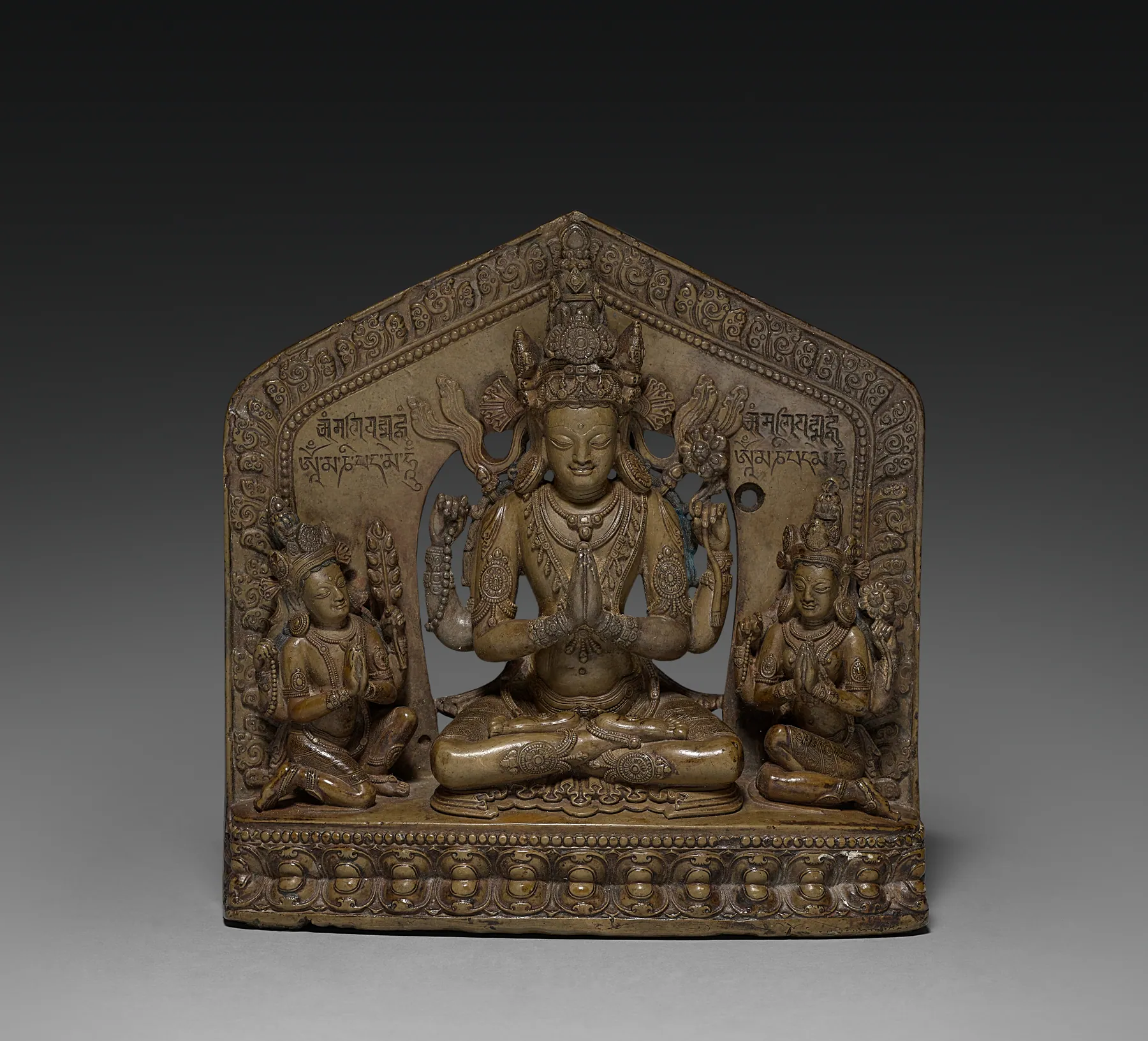
Om mani padme hum is the mantra of Avalokiteshvara, known in Tibetan as Chenrezig, the bodhisattva who embodies the compassion of all buddhas and who is regarded as the special protector of Tibet. Its earliest known source is the Karandavyuha Sutra, an Indian text usually dated to the late fourth or early fifth century, which calls it the six-syllable great knowledge and praises its recitation above other practices. Tibetans learn it in infancy and repeat it throughout life. Its Tibetan pronunciation is om mani peme hung, and it is commonly called simply the mani.
The mantra has six syllables, written in Tibetan script or in the ornamental Indian Lantsa script. The central words are widely translated as jewel in the lotus, though several scholars read manipadme as a single term of address to one who holds the jewel and lotus. Tibetan teaching does not rest on a literal meaning. Each syllable is assigned a colour, white, green, yellow, blue, red and black, and is said to close the door to rebirth in one of the six realms, to purify one of six afflictions and to perfect one of the six perfections. A seventh syllable, hrih, the seed of the deity, is sometimes added.
The mani is the content of most prayer wheels, the text of mani stones and walls, and a frequent inscription on rocks, bells and prayer flags. Lay people count millions of repetitions on the mala, and communities hold retreats to accumulate a hundred million recitations together. The Mani Kabum, a collection of teachings attributed to King Songtsen Gampo, established the mantra’s central place from about the twelfth century. All schools teach it, and the Dalai Lamas and Karmapas, held to be emanations of Avalokiteshvara, have promoted it as a practice suitable for everyone.
In the collection
1 work in the collection relate to Om Mani Padme Hum.
Connections
14 linked records across the archive.
Sources
References consulted for this record.
- 01Om mani padme hum — Wikipedia
- 02Kāraṇḍavyūha Sūtra — Wikipedia
- 03Alexander Studholme, The Origins of Oṃ Maṇipadme Hūṃ: A Study of the Kāraṇḍavyūha Sūtra (SUNY Press, 2002)