FT·ART·099Painting
Bodhisattva Manjushri
early 1700s · Tibet, 18th century
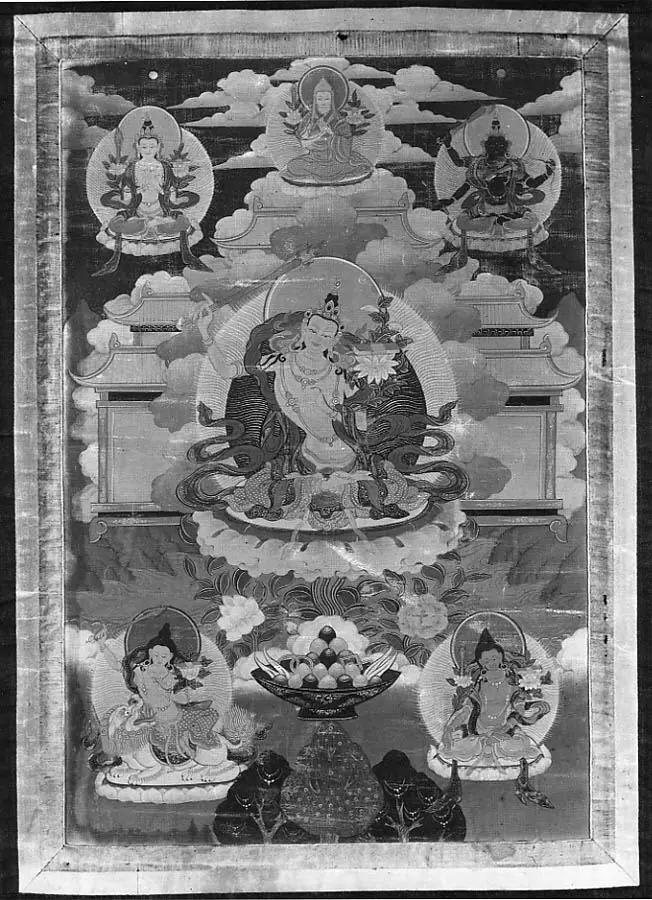
This painting depicts a red standing Manjushri, the bodhisattva of wisdom, shown with his hands in the gesture of teaching. At left, over his shoulder, a flaming sword emerges from a lotus flower, referencing the severing of ignorance. At right, a horizontal manuscript containing the wisdom text sits atop a second lotus flower. He is shown surrounded by a mandorla as a miraculous apparition in a dramatic landscape. Above, the figure on the left can be identified by his pointed red hat as a lineage master of the Sakya order of Tibetan Buddhism. The figure on the right is a layman, as indicated by his nonmonastic robes and long hair. He probably depicts the celebrated Sakya teacher Sonam Tsemo (1142–1182). At the bottom left, White Tara is shown holding a lotus between her thumb and forefinger—the gesture of teaching. Her right hand performs the mudra, or gesture, of supreme generosity, showing that she is giving the gift of teachings, which will bear beautiful results. At the bottom right, the protector Vaishravana is pictured in his wealth deity form, holding a mongoose spitting jewels in his left hand and an individual jewel in his right hand. The altar beneath Manjushri’s feet presents a seed pod, the three jewels, and a conch shell. Bolts of cloth and gems are clustered below as offerings.
Text: The Cleveland Museum of Art, open-access catalogue.
- Date
- early 1700s
- Culture
- Tibet, 18th century
- Medium
- ink and slight color on cotton
- Dimensions
- Overall: 57.6 x 42.4 cm (22 11/16 x 16 11/16 in.)
- Classification
- Painting
- Accession no.
- 1997.305
- Credit line
- Bequest of Lillian M. Kern
- Holding museum
- The Cleveland Museum of Art
- Image rights
- Public domain (CC0)
Depicted and related
Related works
Works that share a subject, a form or a century.