FT·TXT·034Treasure Literature
Bardo Thodol
བར་དོ་ཐོས་གྲོལ
Wyliebar do thos grolDaterevealed 14th century
The Bardo Thodol, Liberation through Hearing in the Intermediate State, is a fourteenth-century treasure text read aloud to guide the dying and the dead toward freedom.
Also known asTibetan Book of the Dead · Bardo Todrol · Liberation through Hearing in the Bardo · Bardo Thodol Chenmo · Great Liberation upon Hearing
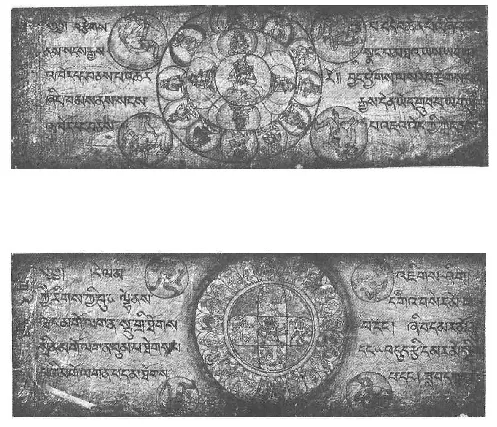
The Bardo Thodol is a set of instructions meant to be read aloud beside a dying or recently dead person. Its title means liberation through hearing in the bardo, the interval between death and the next birth. The text holds that consciousness passes through a series of experiences in this interval and that, if they are recognised as the display of one’s own mind, freedom can be gained at once. It is the Tibetan work best known abroad, under a title that Tibetans themselves do not use.
The treasure revealer Karma Lingpa brought the text to light in the fourteenth century, at Mount Gampodar in the Dakpo region, as part of a larger cycle called the Profound Dharma of Self-Liberation through the Intention of the Peaceful and Wrathful Ones. It describes three intermediate states. At the moment of death the clear light of reality dawns. In the bardo of reality itself the forty-two peaceful and fifty-eight wrathful deities appear over successive days. In the bardo of becoming the deceased is drawn toward rebirth. The reading may continue for forty-nine days.
The work belongs to the Nyingma and Kagyu traditions, and other Tibetan schools use different funeral texts. The first English edition, compiled by Walter Evans-Wentz from a translation by the Sikkimese teacher Kazi Dawa Samdup, appeared in 1927 as The Tibetan Book of the Dead, a title modelled on the Egyptian Book of the Dead. Carl Jung wrote a commentary on it, and it influenced Western ideas about dying. Gyurme Dorje’s 2005 translation was the first to present the complete cycle.
Connections
11 linked records across the archive.
Sources
References consulted for this record.
- 01Bardo Thodol — Wikipedia
- 02Bryan J. Cuevas, The Hidden History of the Tibetan Book of the Dead (Oxford University Press, 2003)
- 03Gyurme Dorje (trans.), The Tibetan Book of the Dead: First Complete Translation (Penguin, 2005)
- 04Donald S. Lopez Jr., The Tibetan Book of the Dead: A Biography (Princeton University Press, 2011)