FT·SYM·040Sacred Diagram & Mantra
Refuge Tree
ཚོགས་ཞིང
Wylietshogs zhingSanskritPuṇyakṣetraDatepaintings mainly from the 18th century
A visualised assembly of teachers, buddhas, deities and protectors, often arranged on a tree, before which practitioners take refuge and gather merit.
Also known asRefuge Field · Field of Merit · Tsokshing · Field of Accumulation · Merit Field
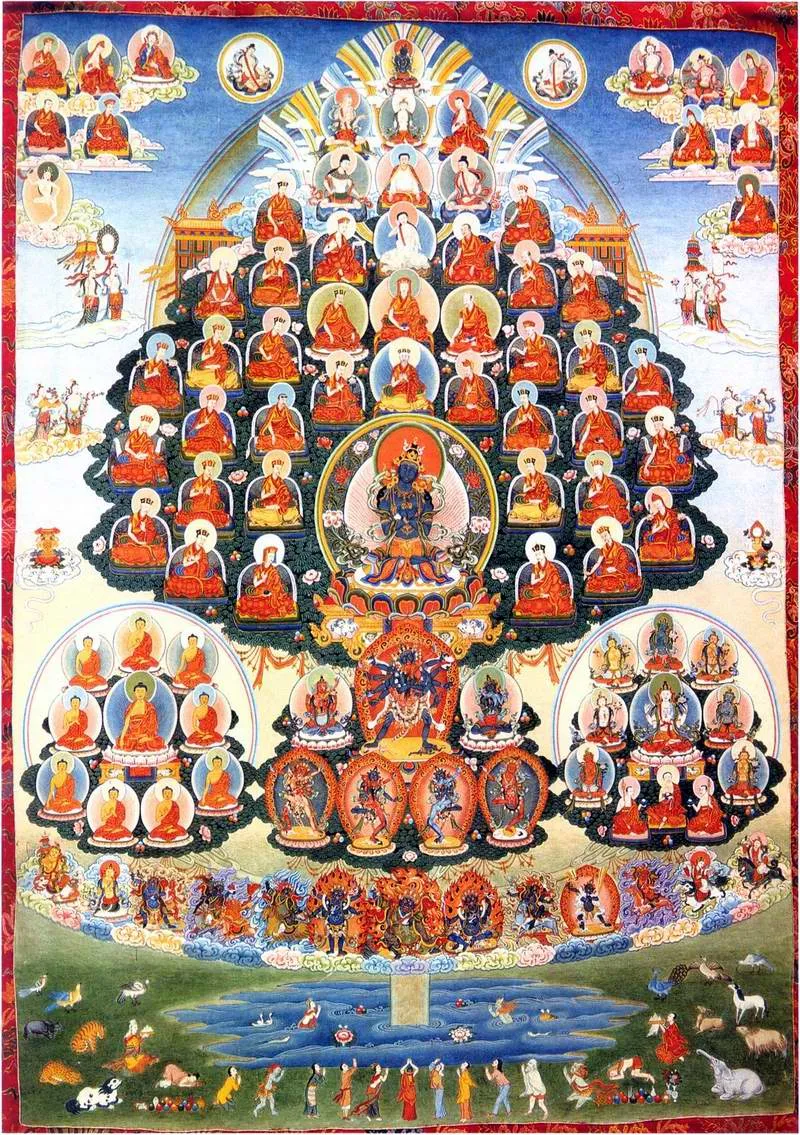
The refuge tree, or field of accumulation, is the gathering of all the sources of refuge of a particular lineage, imagined in the space before the practitioner. It is the focus of the preliminary practices: taking refuge with prostrations, offering the mandala and guru yoga. By making offerings and prayers before this assembly a practitioner is said to gather merit as a farmer gathers a crop from a fertile field. Each school, and often each lineage within a school, has its own arrangement, so a painting of the field is also a statement of spiritual ancestry.
In the tree form a great trunk rises from a lake and divides into a central crown and four branches. The root teacher sits at the centre in the form of a chosen figure: Vajradhara in Kagyu versions, Padmasambhava in Nyingma, and Tsongkhapa with Shakyamuni and Vajradhara at his heart in Gelug. Lineage teachers are ranked above or around. Meditational deities occupy the front branch, buddhas and bodhisattvas the side branches, and the scriptures, stacked as books, the rear. Protectors stand below. Gelug paintings often show the field as a single tiered assembly of figures on a great lotus.
Liturgies describing such fields are known from at least the sixteenth century, including texts by the Ninth Karmapa, and the Gelug form follows the Offering to the Spiritual Master composed by the Fourth Panchen Lama, Losang Chökyi Gyaltsen, in the seventeenth century. Surviving paintings date mainly from the eighteenth century onward, which makes the genre a late development in Tibetan art. The Nyingma tree of the Longchen Nyingtig tradition, described by Patrul Rinpoche, is among the most reproduced today. Practitioners keep a painting or print of their lineage’s field on the shrine as a support for daily practice.
Connections
8 linked records across the archive.
Sources
References consulted for this record.