FT·SYM·021Ritual Implement
Bell
དྲིལ་བུ
Wyliedril buSanskritGhaṇṭā
A bronze hand bell with a half-vajra handle, held in the left hand as the emblem of wisdom, the understanding of emptiness, and paired with the vajra.
Also known asDrilbu · Ghanta · Vajra Bell · Tibetan Bell · Dorje Drilbu
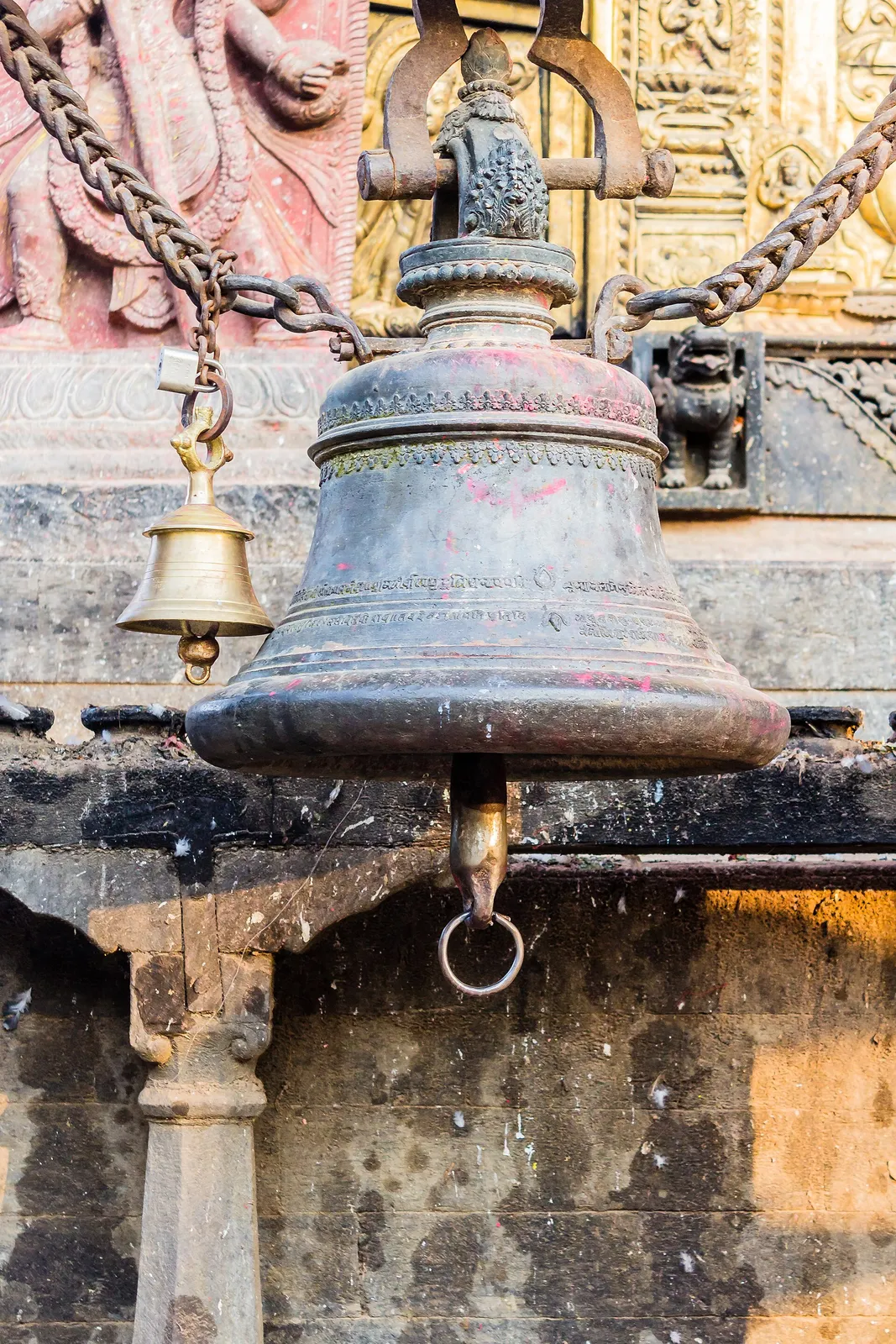
The bell is the partner of the vajra in every tantric ritual. It represents wisdom, the direct understanding of emptiness, and the feminine principle, while the vajra represents method or compassion. Holding both together, with wrists crossed at the heart, expresses their union, which is the tantric definition of awakening. The sound of the bell, which arises and fades without leaving a trace, is itself taken as a teaching on emptiness. It is rung to invite deities, to accompany offerings of music and to mark the transitions of a liturgy.
The bell is cast in a bronze alloy chosen for its tone. Its hollow body is described as the mandala of the wisdom goddess. On the shoulder eight lotus petals bear the seed syllables of eight goddesses. Below them hang loops of jewels issuing from the mouths of monster faces, and a ring of upright vajras circles the rim. The handle, separately cast in brass or gilt bronze, rises from a vase of nectar to the crowned face of the goddess Prajnaparamita and ends in a half vajra with five or nine prongs. The clapper is said to voice the sound of emptiness.
A practitioner holds the bell in the left hand, mouth downward, and sounds it with a turn of the wrist. Bell and vajra are made as a matched pair, proportioned to one another, and are kept wrapped in a brocade case when not in use. Old bells are prized for their tone, and Tibetan connoisseurs distinguish Indian, Chinese and Tibetan castings by shape and sound. The bell is the attribute of Vajrasattva and Vajradhara, who hold it at the hip or crossed with the vajra at the heart, and of many meditational deities shown in union with a consort.
Connections
14 linked records across the archive.
Sources
References consulted for this record.
- 01Ghanta — Wikipedia
- 02Vajra and Bell — Project Himalayan Art, Rubin Museum
- 03Ritual Object: Vajra & Bell Main Page — Himalayan Art Resources
- 04Robert Beer, The Encyclopedia of Tibetan Symbols and Motifs (Shambhala, 1999)