FT·SCI·014Cosmology
Mount Meru
རི་རབ
Wylieri rabSanskritSumeru
Mount Meru is the vast mountain at the centre of the world in classical Buddhist cosmology, ringed by seas, mountain ranges and four continents.
Also known asSumeru · Rirab · Ri rab lhunpo · Mount Sumeru · Sineru
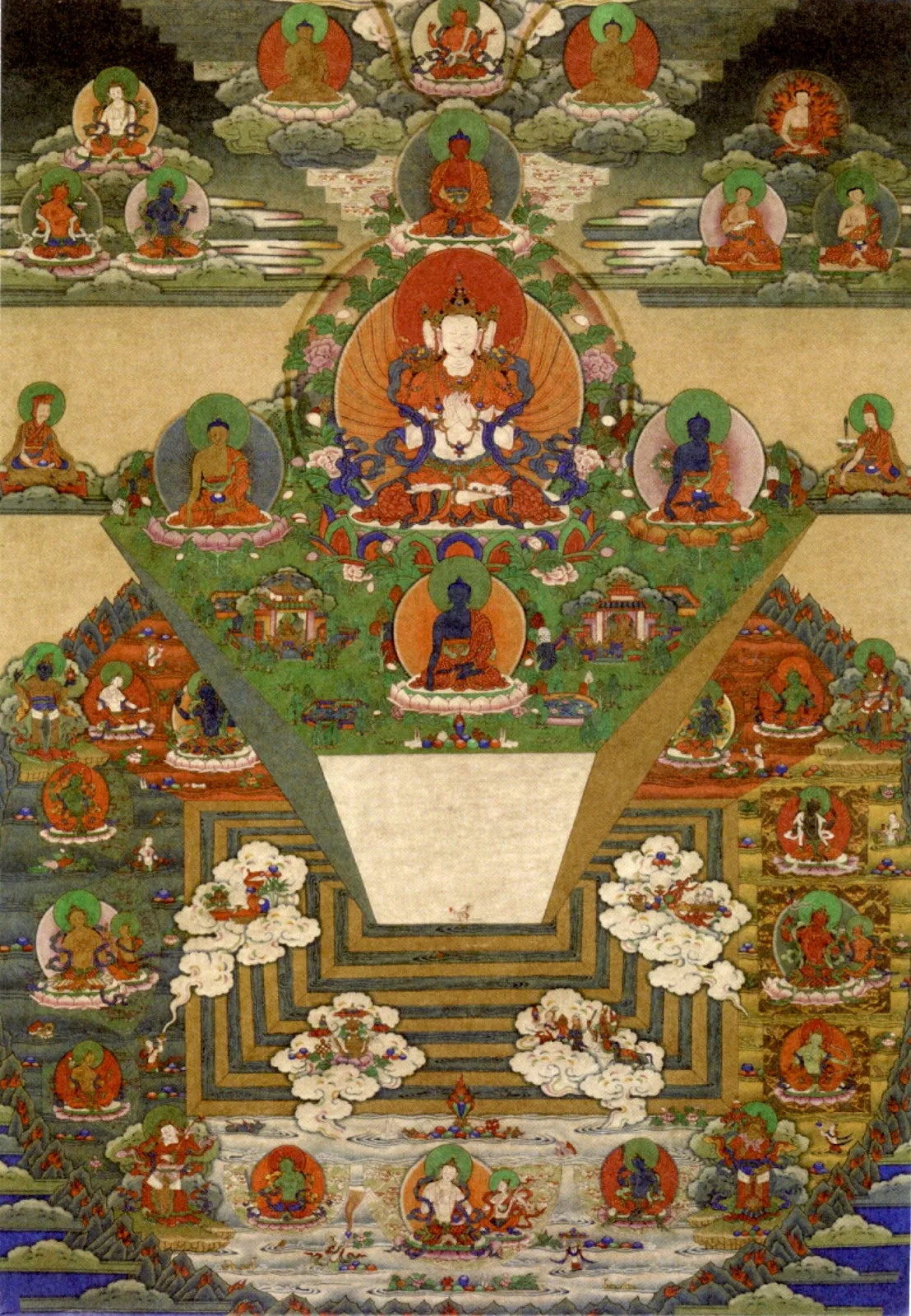
Mount Meru, or Sumeru, is the axis of the world in the cosmology that Tibetan Buddhism inherited from India. It rises from the centre of a great ocean, with the sun, moon and stars circling it. Human beings live on Jambudvipa, the continent to its south. The image organises Buddhist thinking about space, the heavens and the realms of rebirth, and it is reproduced constantly in ritual, art and architecture.
In the account of Vasubandhu’s Abhidharmakosha, Meru stands 80,000 yojanas above the ocean and extends as far below it. It has four faces of precious substances, the southern one of blue beryl, whose reflection is said to colour the sky of our continent. Seven rings of golden mountains and seas surround it, and beyond them lie four continents, each flanked by two smaller ones. The gods of the Heaven of the Thirty-Three dwell on its summit. The Kalachakra Tantra gives a different shape and measurements.
The mandala offering, performed daily by Tibetan Buddhists, presents the whole Meru universe in symbolic form, and the monastery of Samye was laid out on its plan in the eighth century. Mount Kailash in western Tibet is often associated with it. The Fourteenth Dalai Lama has said that the literal Meru cosmology is contradicted by observation and should be set aside, while its symbolic and ritual uses continue.
Connections
15 linked records across the archive.
Sources
References consulted for this record.
- 01Mount Meru (Buddhism) — Wikipedia
- 02Alexander Berzin, Buddhist Cosmology in Abhidharma and Kalachakra — Study Buddhism
- 03Akira Sadakata, Buddhist Cosmology: Philosophy and Origins (Kosei Publishing, 1997)