FT·PLA·003City & Region
Guge Kingdom
གུ་གེ
Wyliegu geDate10th century–1630
Kingdom of western Tibet, founded in the 10th century by descendants of the imperial line, whose rulers sponsored the Buddhist revival led by Rinchen Zangpo.
Also known asGuge · Kingdom of Guge · Guge-Purang · Guge Wangguo
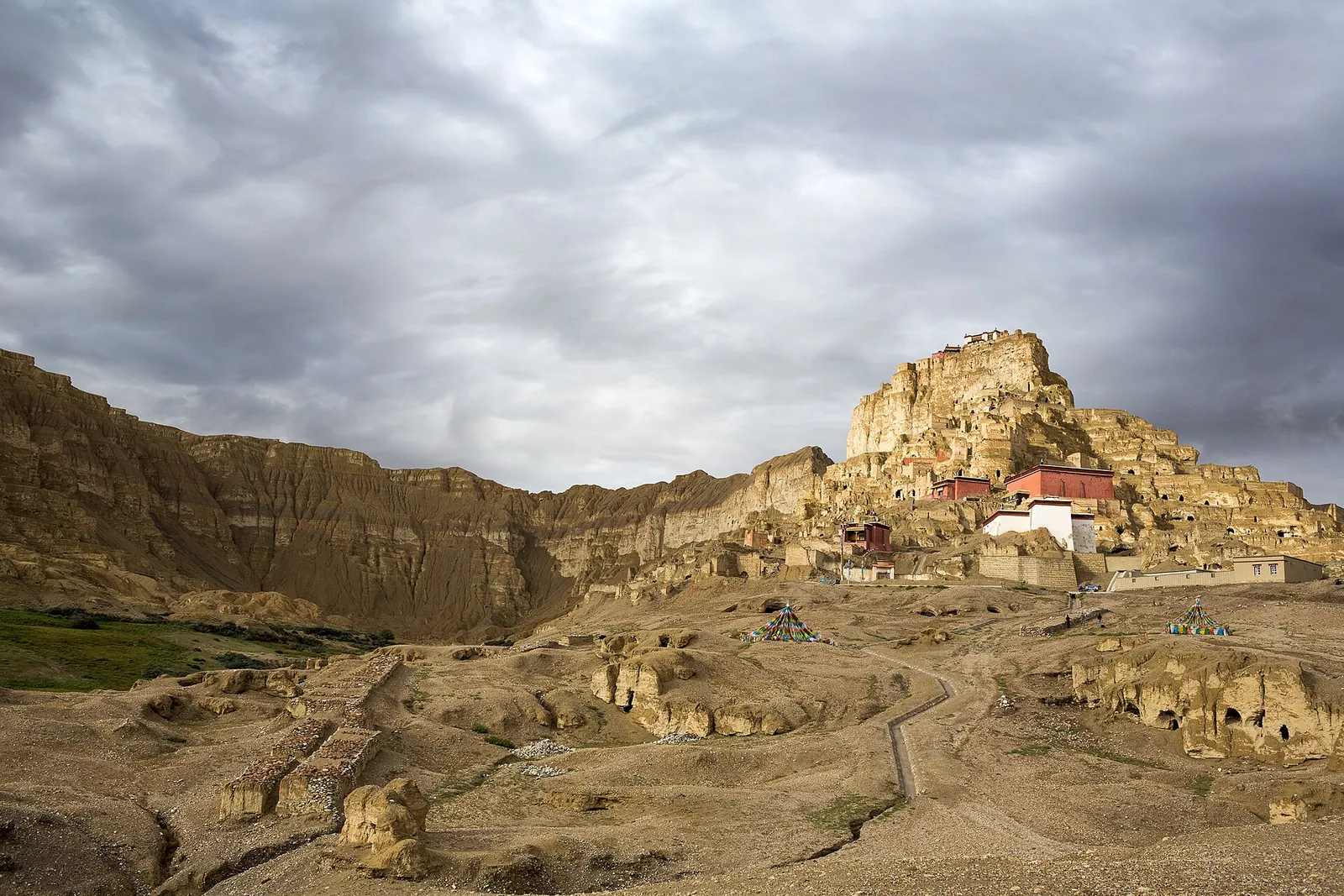
Guge was a kingdom in the canyon country of the upper Sutlej, in what is now Zanda county of Ngari. It was established in the 10th century by descendants of the Tibetan imperial family who had moved west after the empire broke up; the realm of Kyide Nyimagon was divided among his sons into Guge, Purang and Maryul, the last corresponding to Ladakh. Guge matters to the history of Tibetan Buddhism chiefly as the source of the ‘later diffusion’, the revival of monastic Buddhism after a century of decline.
Around the end of the 10th century the king Yeshe-Ö gave up the throne to become a monk, founded the monastery of Tholing, and sent young men to Kashmir to study. One of them, Rinchen Zangpo (958–1055), returned as the great translator of the age and is credited with founding temples from Ladakh to Spiti. In 1042 the Bengali master Atisha arrived at Tholing at the invitation of Yeshe-Ö’s grand-nephew Jangchub Ö, and there wrote his Lamp for the Path to Enlightenment. The kingdom’s two centres were Tholing and the fortress-capital of Tsaparang, some twenty kilometres to the west.
Guge prospered again in the 15th and 16th centuries, the period of the painted temples at Tsaparang and of the Gelug presence at Tholing. In 1624 the Portuguese Jesuit António de Andrade reached Tsaparang and was allowed to build a church. Six years later, in 1630, the kingdom fell to an army from Ladakh, and in the 1680s the region passed under the Lhasa government. Its towns were gradually abandoned. The sites were surveyed by Giuseppe Tucci in the 1930s, damaged during the Cultural Revolution, and are now protected monuments reached by road from Zanda.
Connections
18 linked records across the archive.
Sources
References consulted for this record.
- 01Guge — Wikipedia
- 02Roberto Vitali, The Kingdoms of Gu.ge Pu.hrang (Tho.ling gtsug.lag.khang lo.gcig.stong 'khor.ba'i rjes.dran.mdzad sgo'i go.sgrig tshogs.chung, 1996)
- 03Luciano Petech, The Kingdom of Ladakh, c. 950–1842 A.D. (IsMEO, 1977)