FT·DEI·032Meditational Deity (Yidam)
Vajrayogini
རྡོ་རྗེ་རྣལ་འབྱོར་མ
Wylierdo rje rnal 'byor maSanskritVajrayoginī
The red female buddha of the Chakrasamvara tantras, shown as a sixteen-year-old yogini drinking from a skull cup and holding a curved knife, with a staff on her shoulder.
Also known asVajrayoginī · Dorje Naljorma · Naro Khechari · Naro Khacho · Naro Dakini · Sarvabuddha Dakini
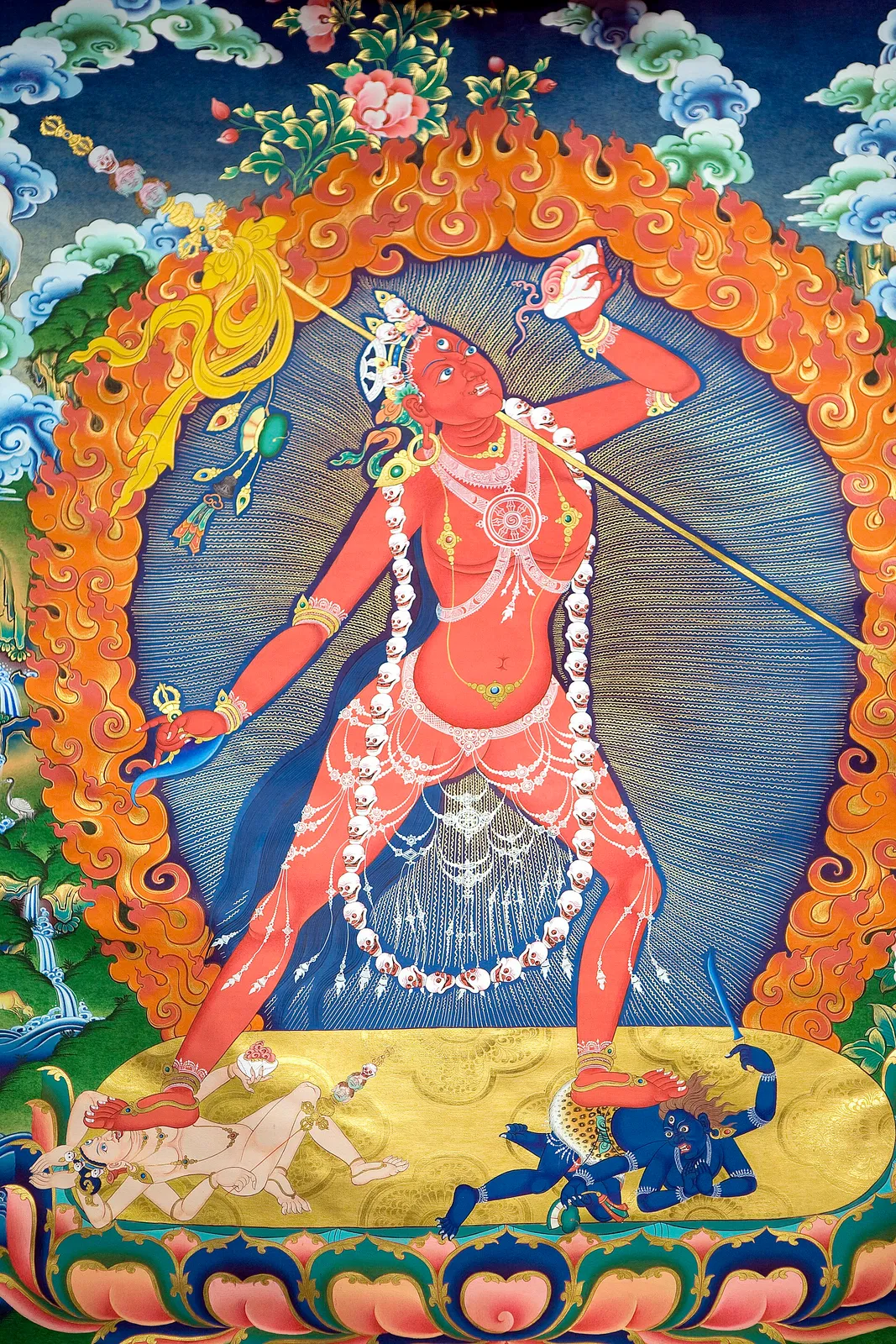
Vajrayogini is the foremost female deity of the Highest Yoga tantras. She is the consort of Chakrasamvara and, practised on her own, the essence of the Mother tantras, embodying the wisdom of bliss and emptiness. The name covers a group of related forms, each named after its appearance or after the Indian adept who first practised it, among them Vajravarahi, the fierce black Krodhakali and the self-decapitated Chinnamunda. Her practice requires initiation and is treated as confidential in every school.
The form called Naro Khechari, ‘the Sky-goer of Naropa’, is the most often depicted. She is brilliant red, with one face, three eyes and two arms, naked except for a crown of five skulls, bone ornaments and a garland of fifty heads. She stands with the left leg bent and the right extended, treading on black Bhairava and red Kalaratri. The left hand raises a skull cup of blood to her upturned mouth; the right, lowered, holds a curved knife. A khatvanga staff, standing for her consort, rests on her left shoulder. In her mandala she stands within two interlocking triangles.
The Sakya school preserves three Vajrayogini lineages, those of Naropa, Maitripa and Indrabhuti, known together as the Three Khechari cycles and included among its Thirteen Golden Dharmas. From the Sakya the Naropa form passed to the Gelug school, where Pabongkha Dechen Nyingpo popularised it in the early twentieth century. Her pure land, Khechara, is the destination sought by her practitioners. Sculptures and thangkas of this form are numerous from the seventeenth century onward, in Tibet, Mongolia and China.
Connections
13 linked records across the archive.
Sources
References consulted for this record.