FT·DEI·025Female Buddha & Goddess
Ushnishavijaya
གཙུག་ཏོར་རྣམ་རྒྱལ་མ
Wyliegtsug tor rnam rgyal maSanskritUṣṇīṣavijayā
The white goddess ‘Victorious Crown’, with three faces and eight arms, commonly shown inside the dome of a stupa; one of the Three Long-Life Deities of Tibet.
Also known asNamgyalma · Uṣṇīṣavijayā · Tsuktor Namgyalma · Usnisavijaya · Vijaya · Victorious Crown Goddess
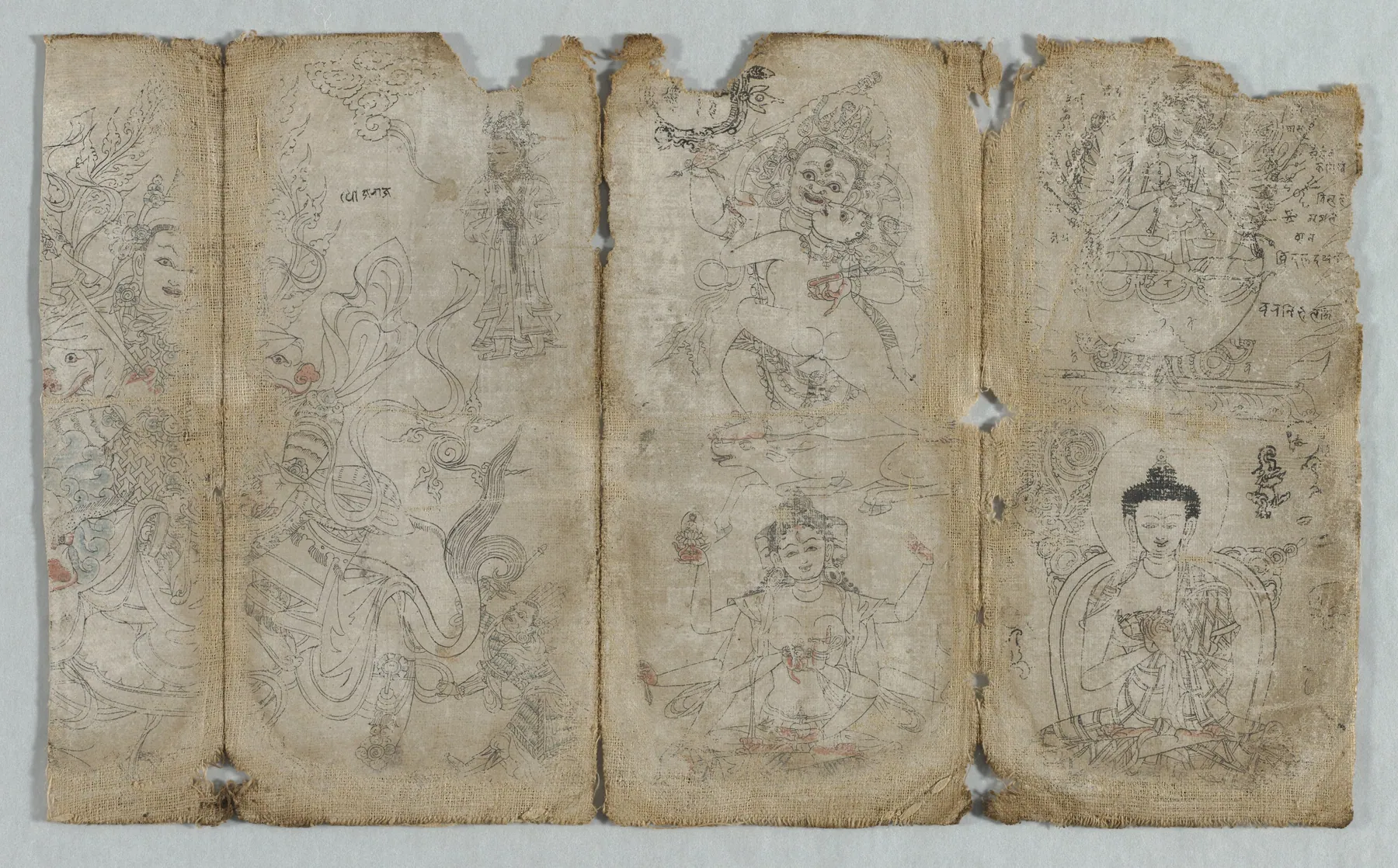
Ushnishavijaya, ‘Victory of the Crown Protuberance’, personifies a dharani, a protective formula. In its best-known version the Buddha teaches it at the request of the god Indra to save a young god from early death and a series of animal rebirths. The Ushnishavijaya Dharani was among the most widely copied Buddhist texts in Asia from the seventh century, inscribed on stone pillars in China and placed inside stupas. In Tibet the goddess is invoked for longevity and the purification of karmic obstacles, alongside Amitayus and White Tara.
She is white, with three faces, white at the centre, yellow to her right and blue to her left, each with three eyes, and eight arms. The right hands hold a crossed vajra at the heart, a small figure of Amitabha on a lotus and an arrow, and make the gesture of supreme generosity. The left hands hold a lasso with a threatening forefinger and a bow, make the gesture of protection, and support a vase of nectar in the lap. She sits in vajra posture in silks and jewels, usually within the dome of a stupa, often flanked by white Avalokiteshvara and blue Vajrapani.
Her nine-deity mandala and her ritual of a thousand offerings are performed in all schools to prolong the life of a teacher or to avert danger. The Namgyal or ‘victory’ stupa, one of the eight canonical types of Tibetan stupa, commemorates the Buddha’s extension of his own lifespan and shares her name. Printed copies of her dharani are placed in prayer wheels, on roof banners and inside images. Gilt sculptures of her are among the commonest female images from Tibet, Nepal, Mongolia and Qing China.
In the collection
1 work in the collection depict or name Ushnishavijaya.
Connections
9 linked records across the archive.
Sources
References consulted for this record.